

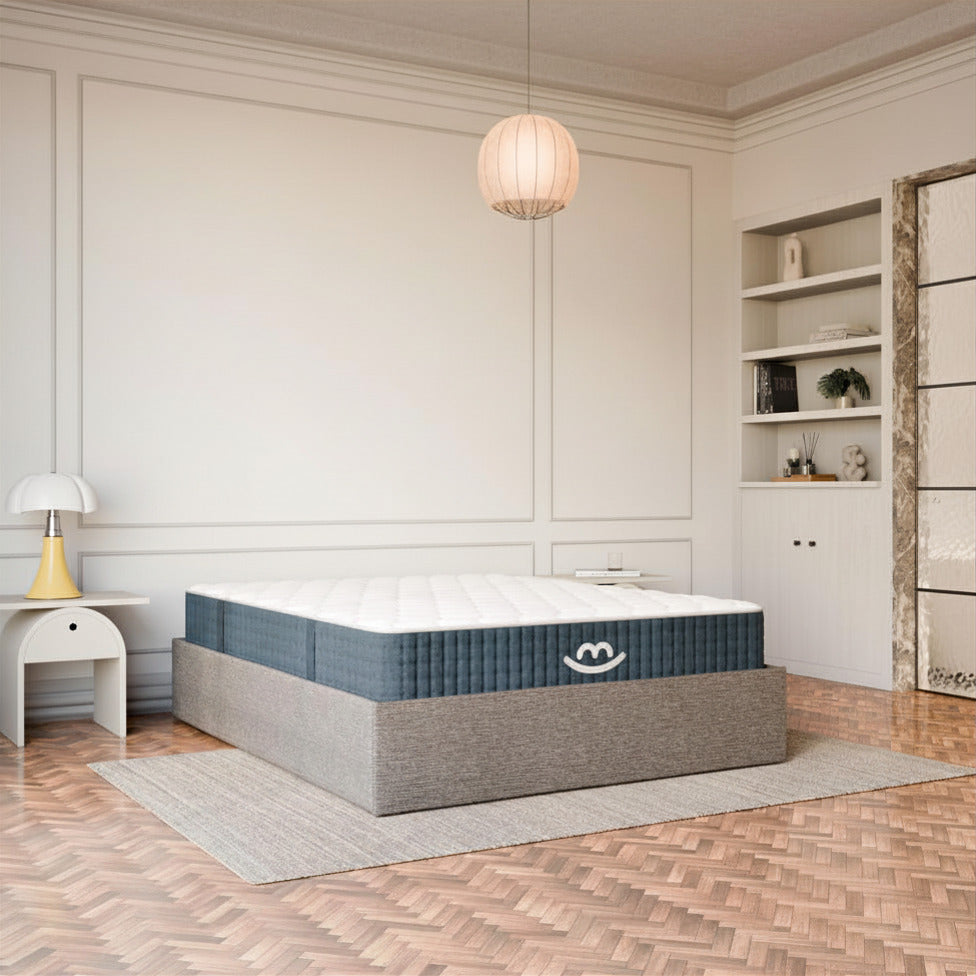

Why does mattress thickness improve comfort?
Mattress thickness isn't just about aesthetics or bed height. It directly affects the quality of your nightly support.
A mattress that's too thin creates excessive pressure points on the hips, shoulders, and lower back. Consequently, you wake up stiff, tired, and feeling like you haven't recovered enough.
A mattress that's too thick without good internal structure offers misleading comfort. What truly matters is the balance between thickness, density, and technology. But let's start with the basics.
💡 Did you know? According to an epidemiological study conducted by Professor Damien Léger from the Sleep and Wakefulness Center at Hôtel-Dieu de Paris, 92% of French people believe that good bedding is important for their health — and 94% consider that it directly improves their sleep quality.
Reference chart: what mattress thickness for which sleeper?
This chart allows you to quickly identify the most suitable mattress thickness for your situation.
|
Thickness |
Ideal Profile |
Mattress Type |
Comfort Level |
|
14 cm |
Child, occasional use |
Basic foam, futon |
Entry-level |
|
18 cm |
Lightweight (<60 kg), daily use |
Foam, latex, memory foam |
Good |
|
20 cm |
Most adults |
All types |
Very good |
|
25 cm |
Couples, demanding sleepers |
Hybrid, pocket springs |
Excellent |
|
30 cm |
Large build, couples, premium comfort |
Premium hybrid |
Hotel-grade |
|
36 cm |
Sleepers seeking ultra-high-end comfort |
Hybrid with integrated topper |
Ultra premium |
Still unsure? Our complete guide to choosing your mattress will help you refine your choice.
Thin mattresses: less than 14 cm
These models are not designed for daily adult use. Their thickness does not allow for proper absorption of pressure points or maintaining the back in a healthy position. They are perfect for babies, young children, or an extra bed for occasional use.
14 to 18 cm: acceptable, but with limitations
This is the range for entry-level mattresses. For a lighter adult or a guest room that isn't used frequently, it can certainly meet the need. For intensive daily use, however, it will quickly reach its limits, especially if the mattress's density isn't up to par.
19 to 25 cm: optimal comfort
This is where most sleepers will find their comfort zone. Each layer has the space to work as it should. At 25 cm, you enter an enveloping and soft realm, close to the feeling you get in a good hotel. Excellent value for quality, durability, and price.
More than 25 cm: uncompromising comfort
Beyond 25 cm, the layers complement each other to offer a result that is both structured and enveloping. Ergofeel foam, memory foam, independent pocket springs—every detail contributes to an exceptional sleep experience. Recommended for larger body types, couples, and those who look forward to that eagerly awaited moment every evening.
Sleeping together: when thickness becomes a couple's issue
We rarely think about it when buying. Yet, sharing a double mattress completely changes the equation. Every nocturnal movement propagates through the mattress and can disturb the other's sleep without anyone being aware of it. Two tired sleepers, and a very real source of tension.
Generous thickness, combined with independent pocket springs, creates true motion isolation. You move, your partner feels nothing. Each in their comfort zone, without compromise.
For two people to sleep comfortably, aim for at least 20 to 25 cm. And prioritize a model whose internal technology is designed for motion isolation.
What mattress thickness should you choose based on your profile?
According to your body type
Your weight exerts real pressure on the mattress every night. The greater this pressure, the more material (in thickness and density) is needed to keep the body in a healthy position and provide truly restorative sleep.
-
Less than 60 kg: 18 to 20 cm may suffice with good mattress density
-
From 60 to 90 kg: 20 to 25 cm, the ideal range for optimal support
-
More than 90 kg: 25 to 30 cm, with a density of at least 80 kg/m³
According to your sleep position
How you sleep determines which areas of your body experience the most pressure. Considering this criterion is as important as your body type.
-
On your side: hips and shoulders sink deeper — 20 to 25 cm to properly absorb pressure points and maintain spinal alignment
-
On your back: 19 to 22 cm offer effective lumbar support
-
On your stomach: a firmer mattress between 18 and 20 cm limits the arching of the lower back. Discover our selection of firm mattresses.
According to your age
-
Babies (0-2 years): 8 to 12 cm maximum, firm mattress, safety is paramount
-
Children and teenagers: 12 to 18 cm, firm support to aid growth
-
Adults: 19 to 25 cm, the universal range
-
Seniors: 20 to 25 cm minimum, with a total bed height of around 55-60 cm to facilitate daily movement
Thickness according to mattress type
Foam and memory foam mattresses
A foam mattress generally ranges from 18 to 25 cm. A memory foam mattress, however, needs at least 20 cm for its viscoelastic layer to react to your body heat, conform to your curves, and relieve pressure points.
Pocket spring mattresses
For a pocket spring mattress, the springs already take up a good portion of the thickness. A minimum of 20 cm, ideally 25 cm, is needed for the comfort layers to fully express themselves. Optimal spinal support and excellent motion isolation.
Hybrid mattresses
A hybrid mattress combines pocket springs with foam or latex. It usually exceeds 23 cm, allowing it to offer the best of both technologies: the bounce of springs and the soft embrace of foam. Recommended for couples and larger body types.
Latex mattresses
Naturally dense and elastic, a latex mattress doesn't need to be very thick. Between 18 and 22 cm, it offers solid support, a nice natural bounce, and excellent durability.
Thickness and density: the two criteria to always consider together
This is the most frequent and costly confusion. Thickness is height. Mattress density is the intrinsic quality of the material, expressed in kg/m³. It determines the durability and quality of support in the long term.
A 30 cm thick mattress with insufficient density will sag in a few years. A 20 cm mattress with good density will faithfully accompany you for ten years. Never look at thickness without looking at density; the two together are what make a truly good mattress.
⚠️ Our recommendation: For a foam mattress, aim for a minimum of 35 kg/m³ for daily adult use.
Mattress toppers: the ideal solution to thicken your bed?
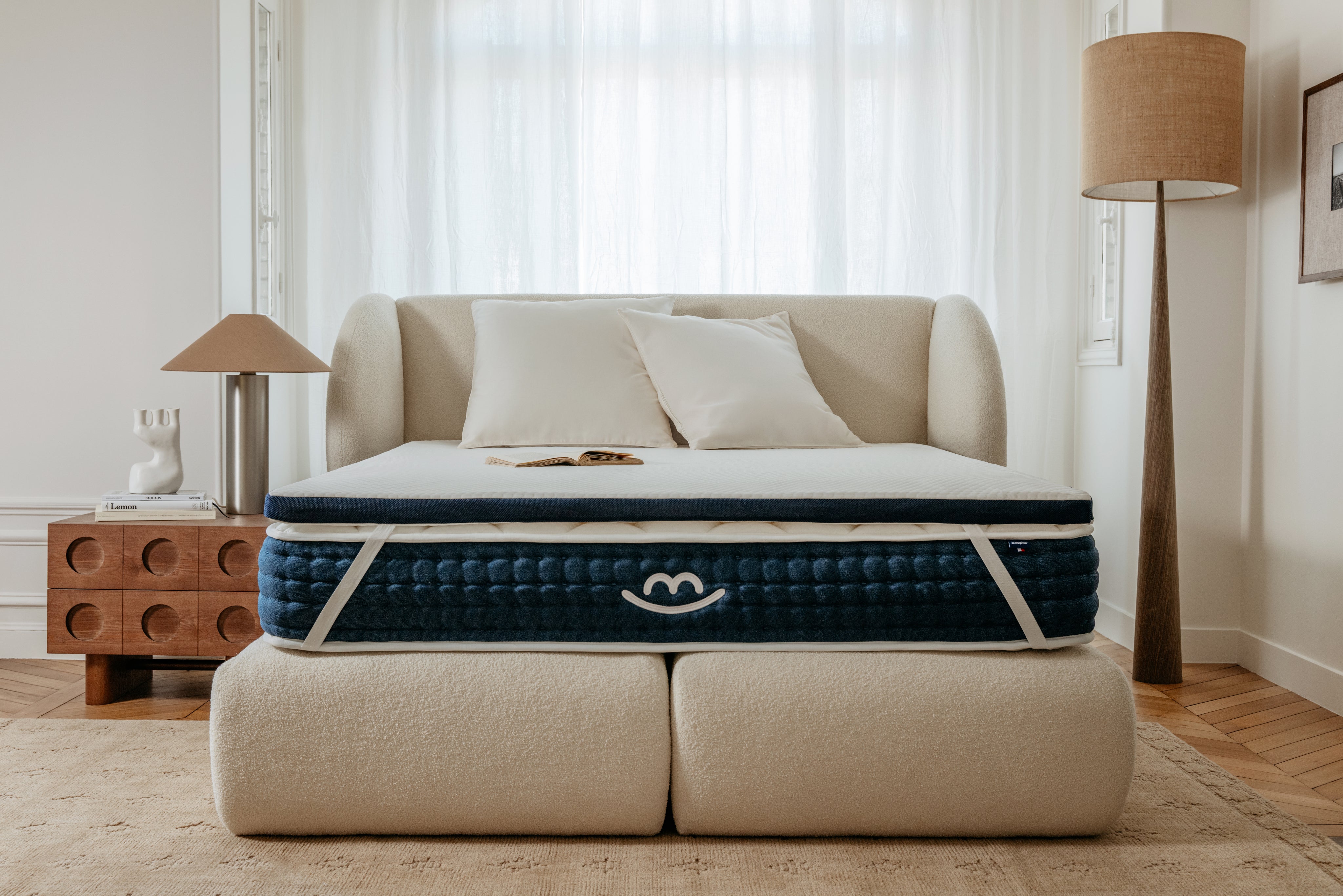
If your mattress is still structurally sound but lacks softness on the surface, a mattress topper can add a few extra centimeters and significantly improve your daily comfort. It's an interesting solution, especially for a guest room or a bed that isn't used frequently.
However, if your mattress sags, dips, or no longer supports you correctly, a mattress topper won't solve the underlying problem. You'll continue to sleep poorly, just with an extra layer of comfort. If you still wake up tired, it's probably time to invest in a new mattress. Your back and your nights will thank you.
Conclusion
Mattress thickness is more than just a number on a product sheet. It's a decision that impacts the quality of your nights and, by extension, your days.
At Morphea, our mattresses are designed with generous thicknesses, quality European materials, and genuine attention to your real comfort.
And to be sure you make the right choice, you have 100 nights to try it out without pressure, without risk.


Morphea or Ikea: which mattress to choose?
Latex and memory foam mattresses: which one to choose?