



Your mattress is getting old or yellowing, and you're starting to see yellow stains on the fabric—don't panic! We'll give you a few tips on how to care for your mattress.
Also, check out our dedicated guide on how to disinfect a mattress without damaging it.
In summary
- Start by vacuuming the mattress, and work by blotting. Rubbing too much spreads the stain and creates rings.
- For a recent stain, opt for a gentle method (lemon juice + lukewarm water or Marseille soap) and keep the mattress barely damp.
- For sweat rings, the baking soda + lemon paste is ideal, then always finish with dry baking soda.
- For an old yellow stain, use 3% hydrogen peroxide + baking soda (test on an inconspicuous area); for very ingrained stains, use washing soda, then ammonia as a last resort (never with bleach).
- For good results, everything depends on the mattress drying: ventilation/fan before making the bed again, and a mattress protector to prevent yellowing from returning.
What causes stains to appear?
Before tackling the issue of yellow stains on white mattresses, and to reassure you, yellow stains can appear quite systematically. They are caused by perspiration, cosmetics, and body oils we use (creams or makeup, for example), sometimes by urine if it's a child's mattress, for instance, and to a rarer but not negligible extent: by overexposure to the sun.
Understanding what caused your mattress to yellow is quite crucial, as you won't clean it the same way depending on whether it's suffered an accident or is yellowing naturally and uniformly.
10 tips for cleaning a yellowed mattress
A yellowed mattress is most often due to perspiration, humidity, or cosmetic residues. To clean it without damaging it, the ideal approach is to proceed in stages: start with gentle solutions, then move on to more powerful options if the stains are old or persistent.
Golden rules before you start: never soak the mattress (it should remain barely damp), dab rather than rub, and always allow to dry completely before making your bed again.
1. Prepare the mattress with a deep vacuum
The first step to cleaning a yellowed mattress is to vacuum it thoroughly.
Instructions:
- Remove all bedding and, if possible, the mattress pad/protector.
- Vacuum slowly with an upholstery attachment: surface, seams, corners.
- If possible, vacuum the underside of the mattress as well.
This first step removes dust, dirt, and dander before cleaning the mattress.
2. For stains and rings: diluted white vinegar then baking soda
Recommended as a first resort for yellow stains related to sweat and light rings.
Instructions:
- Mix 1 cup of white vinegar with 1 cup of lukewarm water.
- Lightly dampen a microfiber cloth (or spray very finely) and blot the yellowed area.
- Let sit for 10 to 15 minutes, then blot with a clean, barely damp cloth (clear water).
- Once the area is almost dry, sprinkle baking soda as a finishing touch.
- Let sit for 2 to 4 hours, then vacuum.
This method prevents saturating the mattress and keeps the baking soda fully effective as a finishing touch (for odors and residual moisture).
3. For ingrained yellow stains: baking soda + hydrogen peroxide
Reserve for older yellow stains or rings: always test on a small, inconspicuous area first.
Instructions:
- Perform a preliminary test on an inconspicuous area (some fabrics may lighten).
- Mix 1 tablespoon of baking soda with a little 3% hydrogen peroxide until a paste is formed (creamy texture). If desired, you can add a teaspoon of dish soap.
- Apply a thin layer to the stain.
- Let sit for 30 to 60 minutes.
- Remove excess with a dry cloth, then finish with a very light wipe with a barely damp cloth if needed.
- Let dry, then vacuum.
Avoid any direct sun exposure during the process (risk of uneven lightening).
4. Sprinkle with dry baking soda to deodorize
An excellent method for finishing touches, especially if the mattress has retained an odor or a slight ring.
Instructions:
- Sprinkle an even layer of baking soda over the area (or the entire mattress).
- Spread with a soft brush if needed.
- Let sit for 4 to 6 hours (or overnight if the odor is persistent).
- Vacuum thoroughly.
This solution absorbs moisture and neutralizes odors naturally and effectively.
5. Marseille soap: gentle daily cleaning
Marseille soap is a great tip if you want to clean a yellowed area of your mattress using only natural products.
- Lightly dampen a sponge, then lather it on the soap.
- Gently clean the area, without soaking the mattress.
- Remove excess with a clean, barely damp cloth.
- Allow to air dry completely before making the bed again.
Morphea Tip: it's better to dab and repeat a second time than to over-wet all at once.
6. Clean a fresh stain with lemon juice
Lemon helps to reduce slight yellowing, especially if you act quickly.
- Apply a little lemon juice (pure or slightly diluted).
- Let sit for 10 to 15 minutes.
- Wipe with a clean, barely damp cloth.
- Allow to air dry.
On delicate fabric, test on an inconspicuous area.
For a already well-marked ring, the lemon + baking soda paste is often more suitable (tip #7).
7. Baking soda + lemon: the anti-ring paste
For yellowed rings (often linked to perspiration), this tip proves to be very effective:
- Sprinkle the stain with baking soda.
- Gently rub the surface with a lemon cut in half to form a paste.
- Use the other half of the lemon when the first one no longer has enough juice.
- Let sit for about an hour.
- Wipe with a clean, dry cloth, then vacuum once the area is thoroughly dry.
- Finish by allowing it to air dry completely.
Important: the sooner you act, the easier it is to eliminate yellow marks before they set in.
8. Soda crystals: for old yellow stains
If gentle methods are not enough, soda crystals can be considered for very stubborn, deeply ingrained stains.
- Wear gloves and ventilate the room.
- Dilute a small amount of crystals in lukewarm water.
- Apply with a well-wrung sponge (the mattress should not be soaked).
- Dab, then wipe with a damp cloth (clear water) to remove residues.
- Allow to dry thoroughly (ventilation recommended).
It is recommended to perform a preliminary test if the fabric is fragile.
9. Ammonia: only as a last resort
Ammonia can be effective, but it should remain a last resort, with precautions.
- Ventilate thoroughly and wear gloves.
- Dilute heavily (a small amount in a lot of water).
- Quickly dab the area, without soaking.
- Rinse lightly with a damp cloth, then allow to dry completely.
Safety: never mix ammonia with other products.
10. Steam cleaner: sanitize and remove surface stains
A steam cleaner can be useful for sanitizing and helping to dislodge some surface dirt, provided that too much moisture is not introduced into the mattress.
- First vacuum the mattress.
- Apply steam quickly, without staying in the same spot.
- Allow to dry completely (open window, ventilation/fan if possible).
- Do not put sheets back on until your mattress is perfectly dry.
Avoid: lingering on one area for too long (risk of rings and odors), putting bedding back on too soon.
Golden rules before you start: never soak the mattress (it should remain barely damp), dab rather than rub, and always allow it to dry completely before making your bed.
If the stain reappears quickly, this may indicate residual moisture: extend drying time and increase ventilation. And to prevent the mattress from yellowing again, appropriate protection (mattress pad/protector) and regular airing often make all the difference.
To go further: discover our mattress care guide with 10 simple tips to extend its lifespan.
Conclusion
Don't worry, a yellowing mattress is not inevitable. By adopting the right method at the right time and with the right ingredients, you can get back a quality mattress that is healthier and more pleasant for everyday use.
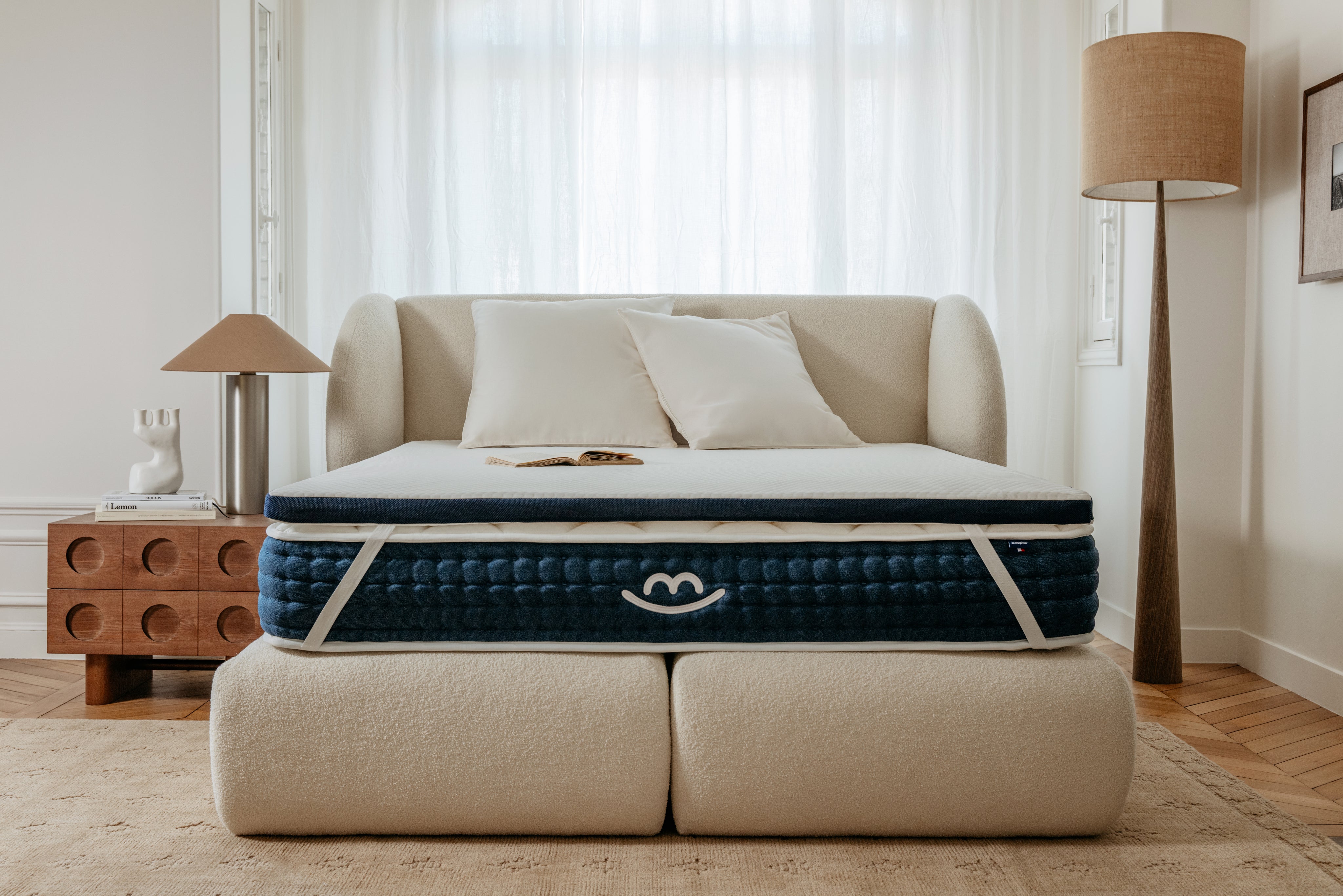
If the stains persist, and you don't want to get rid of your mattress, another solution to consider is opting for a mattress topper. A mattress topper will give you an extra layer of comfort, while providing optimal thermoregulation, and giving you the feeling of having a new mattress.
You can opt for a memory foam mattress topper if your mattress doesn't have one, or a mattress topper with gel beads for a cooling effect, which, in addition to allowing you to fall asleep in hot weather, can be beneficial for people who sweat a lot... and therefore stain their mattress much more!
And if your mattress is nearing the end of its life, Morphea offers high-end models designed for more comfortable and durable sleep, with breathable materials and reassuring certifications.
FAQs
How often should you clean a yellowed mattress, or not?
It is very common practice to clean bed linen: sheets, duvet covers, pillowcases, and even duvets. However, we often forget to perform a thorough cleaning of our mattress... yet, like all fibers, they collect bacteria, and neglecting their maintenance can have consequences on the overall hygiene of your bedroom.
Mattresses, regardless of their composition, need regular maintenance; it is recommended to clean your mattress at least once a year, and ideally every six months.
How to remove yellow stains caused by bedwetting?
First of all, we recommend cleaning this type of stain as soon as possible. A child's mattress cover is often removable and machine washable. As for the mattress filling and core, we recommend making a solution of hydrogen peroxide and baking soda.
With hydrogen peroxide, you will be able to target the areas most affected by urine. First, soak a cloth in hydrogen peroxide – dabbing it on the stained areas, rubbing if necessary until the yellowed stain fades. Then, sprinkle baking soda over the mattress, using a sieve. Let dry for at least 5 hours. If possible, ventilate the room well to speed up drying.
This cleaning will not only wash and thus remove the yellow stain but also disinfect and sanitize the mattress, for even more pleasant nights.
How to remove sweat stains?
More classic and also unavoidable, sweat stains can be quite stubborn. For these, we offer several tips.
The natural solution: lemon juice, mixed with lukewarm water.
If you don't want to use any product, you can opt for a 100% natural technique. You can soak a clean cloth in this lemon/lukewarm water mixture and apply it to the stains. Optimize the effect of the mixture with a brush (a nail brush, for example), making sure to be very gentle. Lemon has a whitening effect, even though it is yellow itself!
The more common solution: a mixture of white vinegar and dish soap.
This solution involves mixing half a liter of white vinegar, 20 cl of lukewarm water, and 2 tablespoons of dish soap. With this mixture, moisten a sponge and dab the stains, letting them air dry or blowing hot air with a hairdryer.
The solution for proven chemists: soda crystals.
Soda crystals act like baking soda. They also have a disinfectant, degreasing, and cleaning effect. Mix them with water, in which they will dissolve. Dip a sponge in this solution and rub the yellowed surface. If the stains are very intense, do not hesitate to go over them twice. Then, with a sponge soaked in clear water, rinse the surface. Then let it air dry or use a hairdryer.
How to remove blood and/or coffee stains?
These stains, in addition to being much more colorful and therefore more visible than yellow stains, have the particularity of needing to be treated with as little heat as possible, so as not to transfer the color (not to "cook" it, in short). Use one of the techniques explained earlier in this guide, but cold or very slightly warm.
How to remove stains from a mattress?
Start by vacuuming, then opt for a light cleaning (the mattress should remain barely damp). As a first step, a mixture of white vinegar and lukewarm water applied by dabbing works well on recent rings. If the stain is light, a gentle cleaning with Marseille soap (well-wrung sponge) may suffice. Ideally, finish by applying dry baking soda, then vacuum once dry: this helps limit odors and residual moisture.
How can I whiten my yellowed mattress?
Start with gentle methods (white vinegar, Marseille soap, baking soda). If the yellow stains are old, 3% hydrogen peroxide can be used locally (with prior testing on an inconspicuous area). The decisive point remains drying; a mattress that is still damp can create new rings.
How to remove old yellow stains from a mattress?
1) Start by lightly cleaning with diluted white vinegar to loosen the stain (dab, do not soak). Vinegar helps dissolve residues (perspiration salts, organic traces) and "awaken" the ring before treatment.
2) Apply a baking soda + 3% hydrogen peroxide paste locally (test on an inconspicuous area first), leave on for 30 to 60 minutes, then remove without scrubbing hard. This is often the most effective method for old yellow stains.
3) Sprinkle dry baking soda (4–6 hours or overnight), then vacuum. This absorbs residual moisture and limits odors.
4) Allow to dry completely (ventilation/open air). A stain can quickly reappear if the mattress does not dry properly.
If the ring is still slightly visible after this, it is sometimes simply a very old oxidized stain: it can often be lightened, but not always made to disappear 100% without risking damage to the fabric.
Does baking soda really clean a mattress?
Baking soda is very effective for deodorizing, absorbing moisture, and neutralizing yellow stains on a mattress. It is particularly effective when applied dry (several hours, then vacuumed). However, to clean a yellowed mattress with old rings, it may not be enough on its own: it is better to combine it with a suitable method (vinegar for light cleaning, or hydrogen peroxide for targeted treatment after testing).
Can you steam clean a yellowed mattress?
Steam cleaning a yellowed mattress helps to sanitize it and remove some surface dirt. The important thing is not to use too much moisture: make quick passes, without lingering in the same spot, then let it dry completely before putting the sheets back on. If the room is humid, good ventilation (or a fan) makes a real difference.
Our latest articles to discover

Best hybrid mattress: selection and comparison 2026 – Morphea

Memory Foam Mattress Topper: The Best Mattress Topper for Back Pain
A memory foam mattress topper is a simple and effective solution for relieving back pain. Thanks to its ability to conform to the body's curves, it perfectly aligns the spine, reduces pressure points, and improves nighttime comfort.
Which bed base to choose for a good night's sleep?
