


Welcome to our guide to caring for your mattress and extending its lifespan. At Morphea, we believe that a good night's sleep starts with quality bedding. That's why we've gathered our best tips to help you pamper your mattress. But before we begin, have you ever considered the impact your bedding has on your sleep and your health?
And also: discover our effective and natural methods for cleaning a yellowed mattress .
Key points to remember:
To extend the life of your mattress and ensure quality sleep, it's important to follow a few practical tips. Here's a summary of the most important points to remember:
- Invest in a quality mattress.
- Use a mattress protector or pad.
- Clean regularly.
- Use a suitable bed base.
- Ventilate daily.
- Add a mattress topper.
Why does mattress maintenance make a difference to the quality of your sleep?
Regular mattress maintenance has three very concrete effects on your health and your sleep:
- Daily hygiene : a mattress “lives” with you (sweat, dust, humidity).
- Long-term comfort : better distributed wear (mattress rotation) maintains a more consistent feel.
- Durability : certain mistakes (too much water, poor drying, aggressive products) accelerate wear much more than time.
Effective maintenance isn't about "cleaning everything all the time." It's about protecting, ventilating, vacuuming, and knowing what to do when a stain appears.
Maintenance frequencies: our recommendations
Proper mattress maintenance relies more on regularity than on occasional deep cleaning. Here's a simple, realistic, and easy-to-follow schedule.
| Que faire ? | Fréquence recommandée | Si allergies / animaux / transpiration |
|---|---|---|
| Aérer la chambre + laisser le lit respirer | Quotidien | Quotidien |
| Laver draps / taies | 1× / semaine | 1× / semaine |
| Aspirer le matelas (surface + côtés + coutures) | 1× / mois | Toutes les 2–3 semaines |
| Nettoyage à sec au bicarbonate | Tous les 2–3 mois | 1× / mois si odeurs |
| Pivoter tête / pieds (et / ou retourner si réversible) | Tous les 3 mois | Tous les 3 mois |
| Vérifier sommier + inspection générale | 2× / an | 2× / an |
Our 10 Morphea tips for mattress care
Tip #1: Invest in a quality mattress
Choosing a mattress is an important decision, so take the time to select a sturdy model that suits your needs. A quality mattress can last for many years, so don't hesitate to invest in a high-end model if your budget allows. But how do you know if a mattress is good quality? There are several criteria to consider, such as density, firmness, composition, and warranty. Feel free to ask our Morphea experts for advice to help you make the right choice.
Tip #2: Protect your mattress
Protecting your mattress from stains and soiling is essential to prolonging its lifespan. Use a mattress protector or pad to prevent stains and damage caused by liquids. You can also use a washable duvet cover to protect your mattress from dust mites and allergens. But did you know that dust mites are one of the leading causes of allergies and asthma? By protecting your mattress, you're also protecting your health.
Tip #3: Clean your mattress regularly
Regularly cleaning your mattress is important to eliminate dust mites, bacteria, and unpleasant odors. Use baking soda or white vinegar to deep clean your mattress. Don't forget to vacuum regularly to remove dirt and pet hair.
But did you know that dust mites can survive for up to 10 weeks in a dirty mattress? That's why it's important to clean your mattress regularly to avoid health problems.
Tip #4: Avoid stains
Stains can damage your mattress and shorten its lifespan. Avoid eating or drinking in bed, and clean stains immediately with a damp cloth and mild soap. But did you know that some stains can be very difficult to remove? That's why it's important to protect your mattress with a mattress protector or pad.
Top tip from Morphéa: Discover how to get rid of yellow stains on a mattress effortlessly
Tip #5: Rotate your mattress
Rotating your mattress regularly can help distribute wear and tear and extend its lifespan. Rotate your mattress every three to six months to prevent sagging and deformation. But did you know that deformation can cause back and neck pain? By rotating your mattress, you can prevent these health problems.
Tip #6: Use a suitable bed base
A suitable bed base can help extend the life of your mattress by providing adequate support. Avoid bases that are too soft or too firm, and opt for a slatted or sprung base. But did you know that slatted bases can help reduce pressure points and improve blood circulation? That's why it's important to choose a bed base that's right for your mattress and your needs.
Tip #7: Air out your mattress
Regularly airing your mattress can help eliminate moisture and unpleasant odors. Remove the sheets and blankets from your bed every morning to allow your mattress to breathe. But did you know that moisture can promote the growth of dust mites and mold? By airing your mattress, you can prevent health problems.
Tip #8: Avoid jumping on the bed
Jumping on the bed might seem fun, but it can damage your mattress and shorten its lifespan. Avoid jumping on the bed or sitting on the edge of the mattress for extended periods. This can cause sagging and deformation that may be difficult to repair.
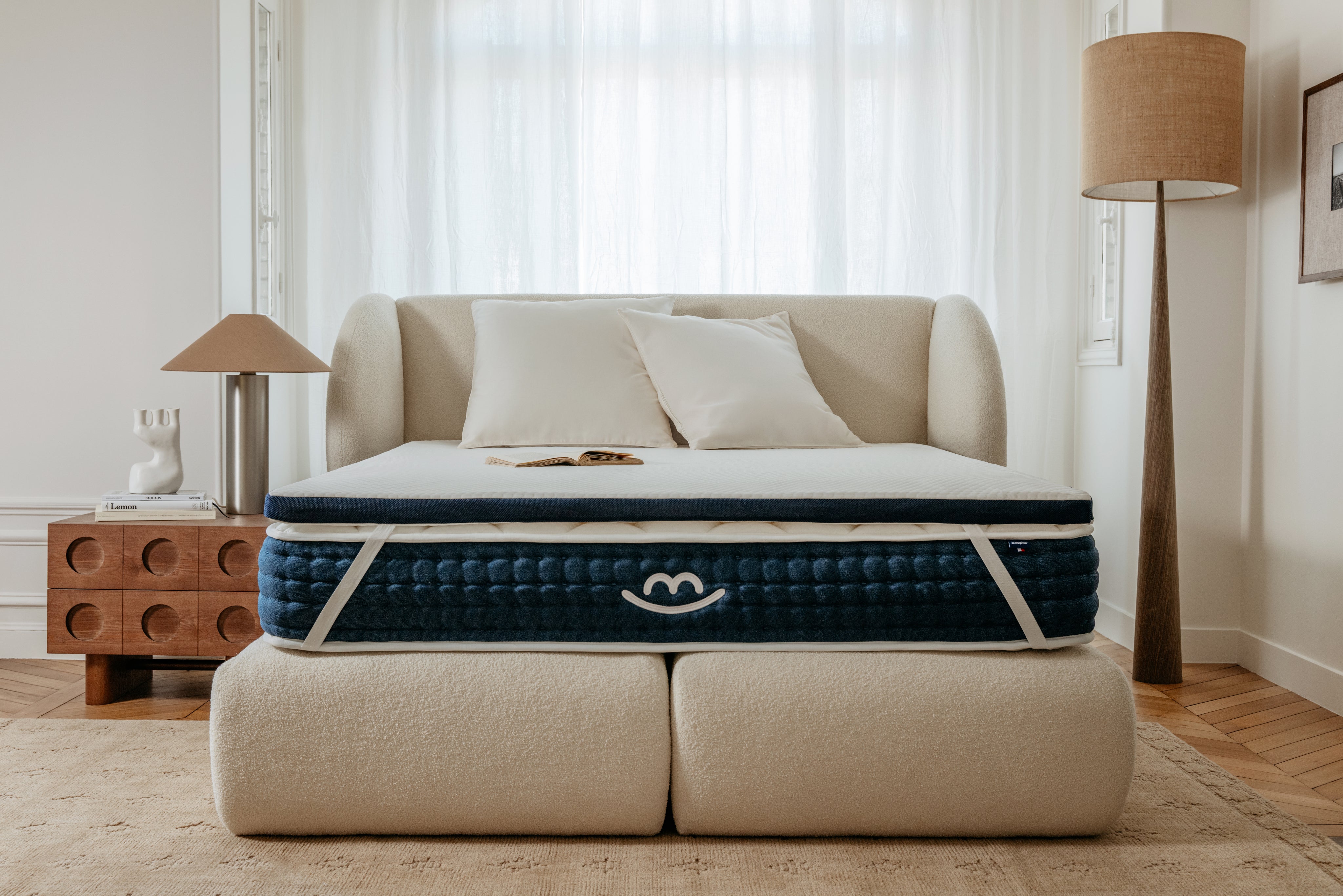
Tip #9: Use a mattress topper
A mattress topper can help extend the life of your mattress by adding an extra layer of comfort and protection. Mattress toppers can also help reduce pressure points and improve blood circulation. Choose a quality mattress topper that suits your mattress and your needs:
Tip #10: Hire a professional
If your mattress is very dirty or damaged, it may be best to have it professionally cleaned or repaired. Professionals have the tools and expertise to thoroughly clean your mattress and repair any damage. This can be a worthwhile long-term investment to extend the life of your mattress.
Dry cleaning the mattress: the safest method
If you could only remember one method of mattress care, it would be this one: it refreshes, limits odors and prevents moisture from being trapped in the materials.
- Vacuum thoroughly (surface + sides + seams).
- Sprinkle a thin layer of baking soda (no need to use too much).
- Leave to act for 30 minutes to 1 hour (up to 4–8 hours if strong odor).
- Brush very gently if the fabric allows, then vacuum again.
- Ventilate (open window if possible).
Morphea's tip: doing this cleaning in the morning helps to allow the mattress time to breathe all day.
Clean stains without damaging the mattress
Always blot dry, avoid soaking, and ensure the stain is completely dry. Effective mattress care often hinges on proper drying. Here are our recommendations for different types of stains:
| Situation | 1er geste (immédiat) | Nettoyage conseillé | Finition | Point critique |
|---|---|---|---|---|
| Auréoles / transpiration | Aspirer | Chiffon légèrement humide + savon doux dilué | Bicarbonate à sec | Séchage total |
| Urine | Tamponner / absorber | Eau froide + savon doux dilué (très peu) | Bicarbonate | Odeur = humidité résiduelle |
| Sang | Tamponner eau froide | Progressif, sans frotter fort | Bicarbonate | Jamais eau chaude |
| Odeurs (tabac/transpi) | Aérer + aspirer | Nettoyage à sec bicarbonate | Aspiration | Vérifier humidité pièce |
| Tache grasse | Absorber le surplus | Terre de Sommières (à sec) | Aspiration | Ne pas étaler |
| Humidité / début de moisissure | Ventiler + sécher | Nettoyage localisé doux (prudent) | Aération longue | Si étendu = avis pro |
Morphea tip: Check out our article if you are looking for a dedicated method to disinfect your mattress .
Mattress care according to technology
Not all mattresses react the same way. "Expert" mattress care is adapted to the material: what is harmless on a textile can be risky if it allows moisture to penetrate the core.
| Technologie | Entretien courant (préventif) | Avec quoi nettoyer (taches) | Méthode recommandée | À éviter absolument |
|---|---|---|---|---|
| Mousse / mémoire de forme | Aspirer 1×/mois + aération + protection lavable | Savon doux (type liquide vaisselle) très dilué + eau froide/tiède en micro-quantité | Appliquer la solution sur un chiffon (pas sur le matelas) → tamponner → absorber avec linge sec → aérer longtemps | Détremper, vapeur insistante, séchage insuffisant (odeurs/humidité piégée) |
| Latex (naturel ou synthétique) | Aspirer + aération régulière | Savon doux dilué (très peu). Pour odeurs : bicarbonate à sec | Tamponner très localisé → sécher à l’air libre → bicarbonate si besoin | Produits abrasifs/agressifs, humidité prolongée, surmouillage |
| Ressorts ensachés | Aspirer coutures/côtés + inspection | Savon doux dilué + eau minime | Nettoyage localisé sans faire pénétrer l’humidité vers le cœur → séchage minutieux (ventilation) | Lavage à l’eau / injection d’eau, séchage bâclé |
| Hybride (ressorts + couches mousse/latex) | Aspirer + aérer + rotation planifiée | Savon doux dilué (très peu) + bicarbonate (odeurs) | Traiter comme un ressort : micro-humide, très localisé, séchage long | Détrempage (double risque : cœur + couches d’accueil) |
| Déhoussable (housse zippée lavable) | Aspirer le cœur + laver la housse | Priorité à la housse (suivre l’étiquette). Pour le cœur : savon doux très ponctuel | Housse lavée + cœur aéré + nettoyage minimal localisé | Tremper le cœur, multiplier les produits “par sécurité” |
| Fibres naturelles / futon | Aération fréquente + aspiration douce | Savon doux très dilué (léger) | Tamponner → sécher longuement à l’air | Humidifier fortement, sécher insuffisant (marques/odeurs) |
Insert a box: ⚠️Products to avoid and precautions
- Never mix bleach with vinegar/descaler (acid): risk of releasing irritating gases.
- Never mix bleach with ammonia : risk of irritating chloramines.
- Always opt for gentle solutions, in small quantities, and maximum ventilation .
Conclusion
Successful mattress care is based on a simple logic: protect, air, vacuum, react quickly in case of stains, and avoid mistakes (too much water, poor drying, unsuitable products).
By keeping these guidelines in mind, you extend the lifespan of your bedding while maintaining a more comfortable and healthier sleeping environment on a daily basis.
FAQ
How to properly care for your mattress?
Proper mattress care rests on four pillars: washable protection (mattress protector, cover, mattress pad), regular airing, vacuuming (surface and seams), and rotation according to the mattress design. The goal is to limit moisture and soiling without over-cleaning the core of the mattress.
How to clean a mattress without washing it?
The safest method is dry cleaning : thorough vacuuming, a thin layer of baking soda, letting it sit for a while, then vacuuming again. This approach refreshes the bedding without risking trapping moisture in the mattress materials.
How to sanitize a mattress?
“Sanitizing” primarily means reducing humidity, odors, and allergens: airing the room, vacuuming regularly, using dry baking soda if necessary, and washing mattress protectors. “Strong” disinfection is rarely necessary on a daily basis and can be counterproductive if it makes the mattress too damp.
How often should you clean your mattress?
For standard cleaning, we recommend vacuuming once a month, using baking soda every 2–3 months, and rotating the dryer approximately every 3 months (if the model allows). Regarding indoor air quality, ANSES recommends opening windows for at least 10 to 15 minutes a day, which also helps maintain good bedding hygiene.
Why put baking soda on a mattress?
Baking soda helps absorb some odors and freshen the surface without wetting the mattress. It's especially useful between more thorough cleanings, provided you vacuum well afterward.
What is the average lifespan of a mattress?
Generally speaking, the lifespan of a mattress is a maximum of 10 years. However, the number of years is not the only indicator, but rather the appearance of signs such as significant sagging, discomfort, painful awakenings, persistent odor despite maintenance, or moisture problems.
Is it better to clean a mattress with steam or with a vacuum cleaner?
For routine maintenance, vacuuming is the safest option. Steam can be used with caution, but it increases the risk of deep moisture penetration; if used, it must be applied sparingly and ensure thorough drying.
Our latest articles to discover

Which bed base to choose for a good night's sleep?
Mattress too hard: what can you do to sleep better?
Latex and memory foam mattresses: which one to choose?
