

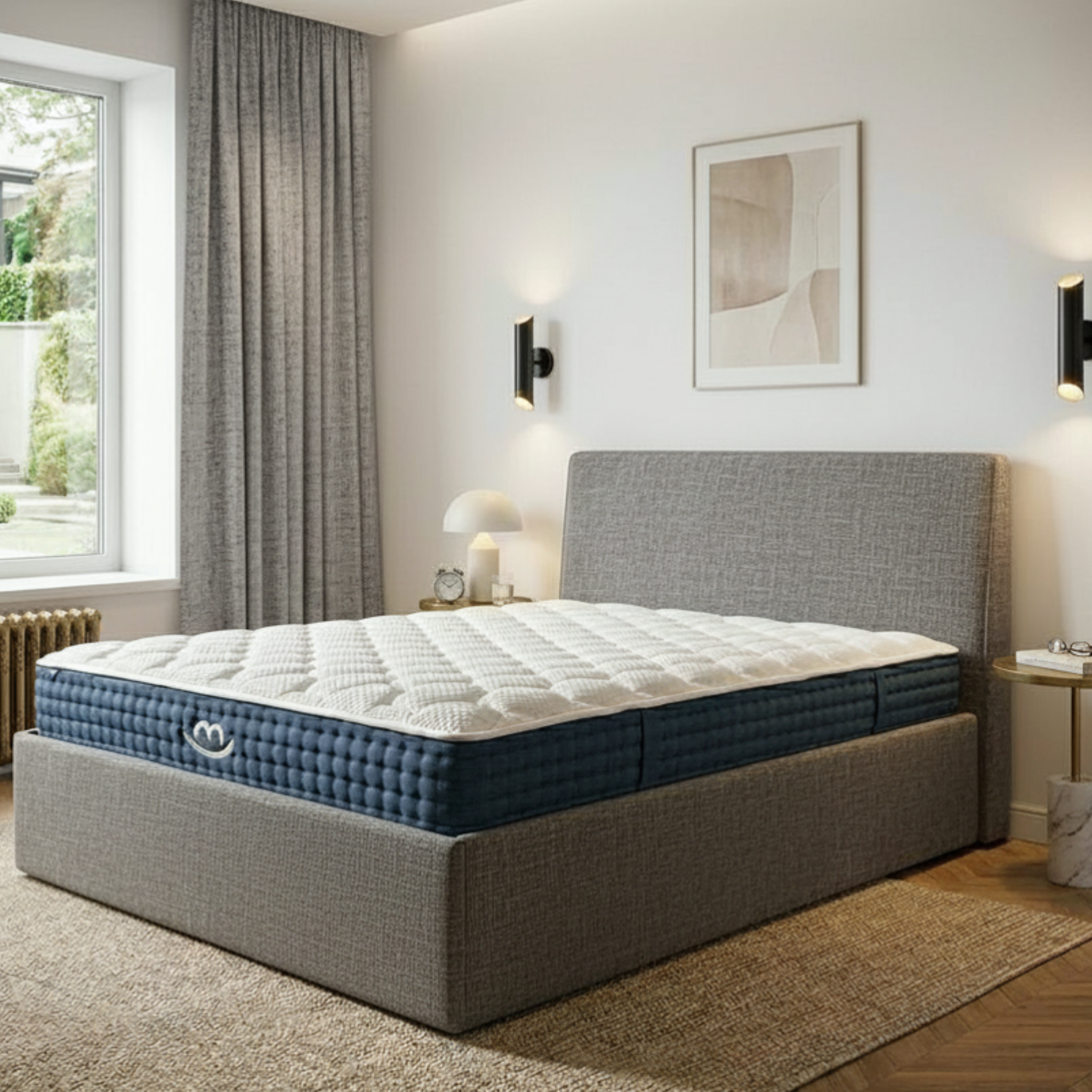

Can a mattress that's too firm harm your sleep?
A very firm mattress might seem reassuring at first. We often think it will support the back better, and therefore will necessarily be better for sleeping.
In reality, when it's too rigid, it can have the opposite effect. The body sinks in too little, pressure points increase, and certain areas like the shoulders or hips bear more of the impact. If you sleep on your side, spinal alignment can also become less natural.
The problem is not the support itself, but excessive firmness, especially if it doesn't match your body type or sleep preferences. A good mattress should support the body without immobilizing it. It should follow your curves without creating unnecessary muscle tension. This balance is what allows for truly restorative sleep.
How to tell if your mattress is too firm for you?
Do you wake up in the morning feeling stiff? As if the night wasn't truly restful?
The signs that your mattress is too firm are often quite clear. You wake up with aches and pains. Your shoulders are sensitive. Your hips feel like they've carried the weight all night. And you tend to change position often, never finding your comfort zone.
A mattress that's too firm can also lead to lighter sleep. You sleep, yes, but you don't recover as well. The body doesn't relax properly, micro-awakenings become more frequent, and restorative nights become rarer. If this feeling recurs for several days in a row, it's best not to ignore it.
It's also important to distinguish between a firm mattress and a truly overly firm mattress. Good support is not unpleasant. On the contrary, it supports the body without creating blockages. But when your comfort disappears in favor of a too-rigid sensation, you need to act.
Add a layer of comfort with a mattress topper
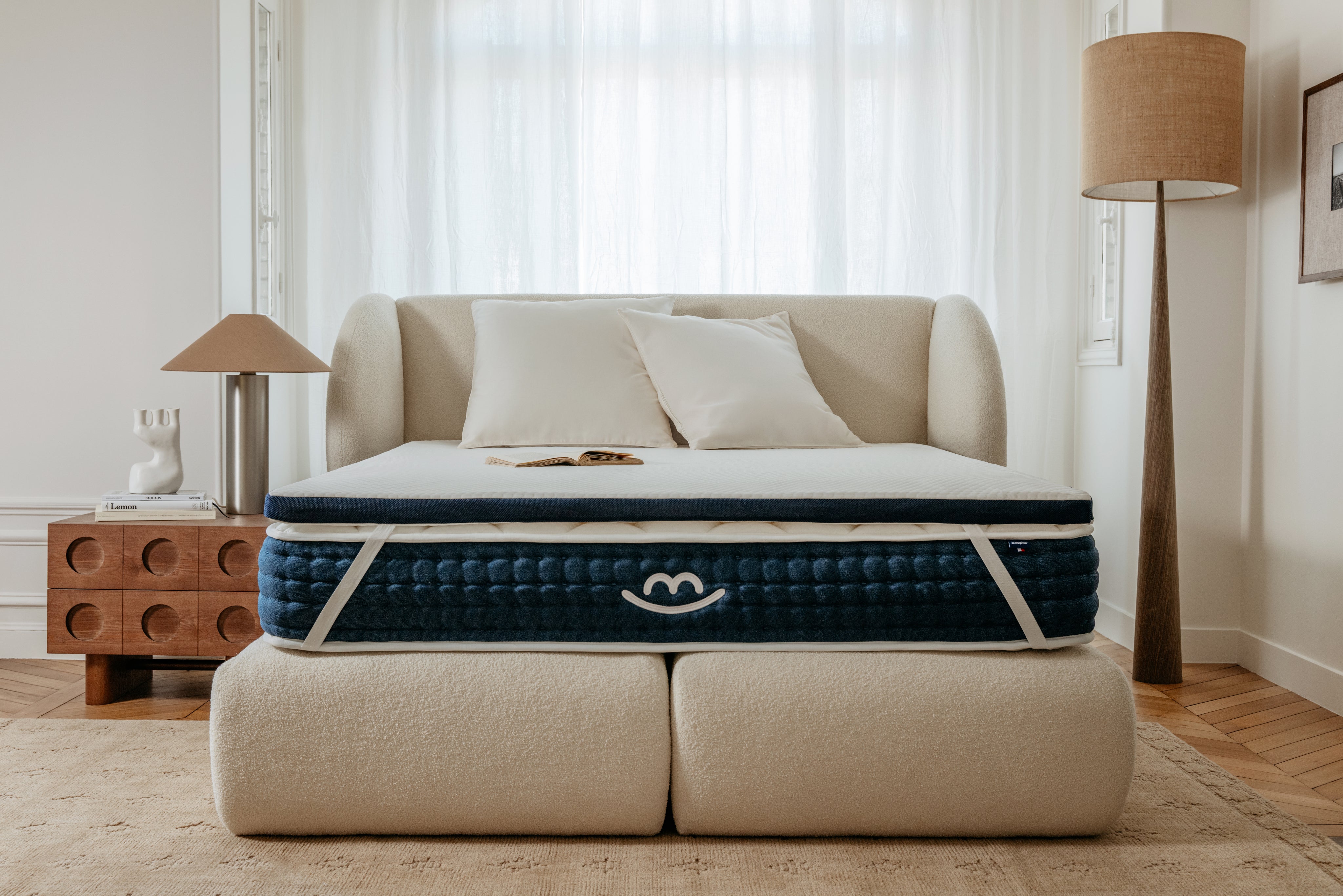
In most cases, the best (and simplest) solution is to add a mattress topper. This is the most effective way to improve the comfort of a too-firm mattress without having to replace all your bedding.
A quality mattress topper adds a softer layer to the surface. It softens the feel and reduces pressure points. And it also allows you to retain some of the support from the original mattress. In other words, you're not starting from scratch. You're correcting what's missing.
It's also the most flexible option if your mattress is still in good condition (less than 10 years old, well-maintained). If your bed is healthy but simply too firm for you, a soft mattress topper can be enough to transform your nights.
Which mattress topper to choose to soften a too-firm mattress?
The right choice largely depends on the comfort you're looking for.
Memory foam mattress topper
If you're looking to relieve pressure points, memory foam is the most logical option. Memory foam reacts to body heat. It better conforms to the body's contours and distributes pressure more progressively. A soft and cozy sensation to add to your too-firm mattress.
This is the whole point of Morphea's Cloudy mattress topper. This 5 cm mattress topper includes 2 cm of memory foam, with breathable foam and a washable cover. It is designed to provide more softness without unnecessarily weighing down the bed.
Latex mattress topper
A latex mattress topper is suitable if you're looking for softer, but also more breathable, comfort. It offers a pleasant feel, often with a more responsive sensation than memory foam. It's also an interesting material if you're sensitive to body heat and want to avoid a bed that's too warm.
Latex is often appreciated for its bouncy feel and good ventilation. It can therefore be a very balanced solution if you want to soften the mattress without enhancing the feeling of being enveloped.
Feather mattress topper
If you're mainly dreaming of a softer, cozier bed, a feather mattress topper can also be an excellent choice. It provides a generous, lofty, and above all, very plush feel.
In this material, our high-end Drimz mattress topper with its duck feather filling is specifically designed to offer extra soft comfort, with a true cloud-like effect.
How to choose a mattress topper without making a mistake
Choosing a mattress topper isn't just about adding an extra layer. It's mainly about correcting a comfort imbalance without creating the opposite excess.
According to your sleeping position
If you sleep on your side, it's better to opt for a softer feel. This is often the best way to relieve the shoulders and hips, which experience more pressure in this position. In this case, memory foam is often a very good choice.
If you sleep on your back, the goal is rather to maintain good support while slightly softening the feel. The comfort should become more pleasant, without the pelvis sinking in too much.
According to your sensitivity to heat
If you already get hot at night, the issue isn't limited to softening the bed. You also need to make sure not to accentuate body heat. In this case, it's better to look at a latex mattress topper or well-ventilated foam.
If, on the contrary, you are mainly looking for a softer, more enveloping sensation, a feather mattress topper might be the right answer.
According to the comfort you are looking for
Everything also depends on what you expect from your bedding. If you simply want to reduce tension and better distribute pressure points, memory foam is often the most suitable. If you want to find a softer, plumper, almost cozier bed, feathers will make more sense.
The goal is not to transform a too-firm mattress into a too-soft mattress. When the pelvis sinks in too much, the alignment of the spine can also deteriorate. The right mattress topper for you is therefore the one that adds just enough softness to regain your comfort zone.
And if you sleep as a couple, also consider your differences in perception. It happens that a mattress seems too firm to one person but not to the other. In this case, you need to look for a solution that improves the feel without unbalancing the entire bed.
Is your mattress too firm because of the bed base?
We often forget, but the mattress never works alone. The support also counts in the overall feel.
If the bed base is old, too rigid, or poorly suited, the sensation of firmness can be accentuated. Sometimes, we blame the mattress, when the complete duo simply lacks flexibility. That's why you need to look at the whole picture.
Good comfort comes from a balance between the mattress, the support, and the feel. There's no point in adding layers if the base itself is no longer sufficient.
Should you invest in a new mattress?
Let's be honest. A mattress topper can significantly improve the comfort of your bed. But it doesn't solve everything.
If your mattress is old, worn, or poorly adapted to your body type, it will quickly reach its limits. If, despite adding a mattress topper, morning aches persist, you may need to reconsider the mattress itself.
This is often when the right question comes up: should you correct the comfort, or start with a fairer foundation? If the mattress no longer properly supports the body, or if it no longer meets your needs, the best decision is sometimes to change the model.
In this case, you can discover our selection of comfort mattresses, designed for those who are looking for a more pleasant feel, without compromising on support.
Conclusion
A good mattress doesn't necessarily have to be "hard" or "firm" to be effective. It needs to be well-balanced according to your profile. Firm enough support to maintain proper spinal alignment. And a soft enough feel so that the body can finally release muscle tension.
If your mattress is too firm, the right reflex isn't necessarily to change everything. Sometimes, it's enough to add a well-chosen mattress topper; sometimes, you need to re-evaluate the support. And sometimes, you have to accept that your body is asking for something else.
The important thing is to find a bed where you finally want to relax. For truly restorative nights.


Latex and memory foam mattresses: which one to choose?
Which bed base to choose for a good night's sleep?